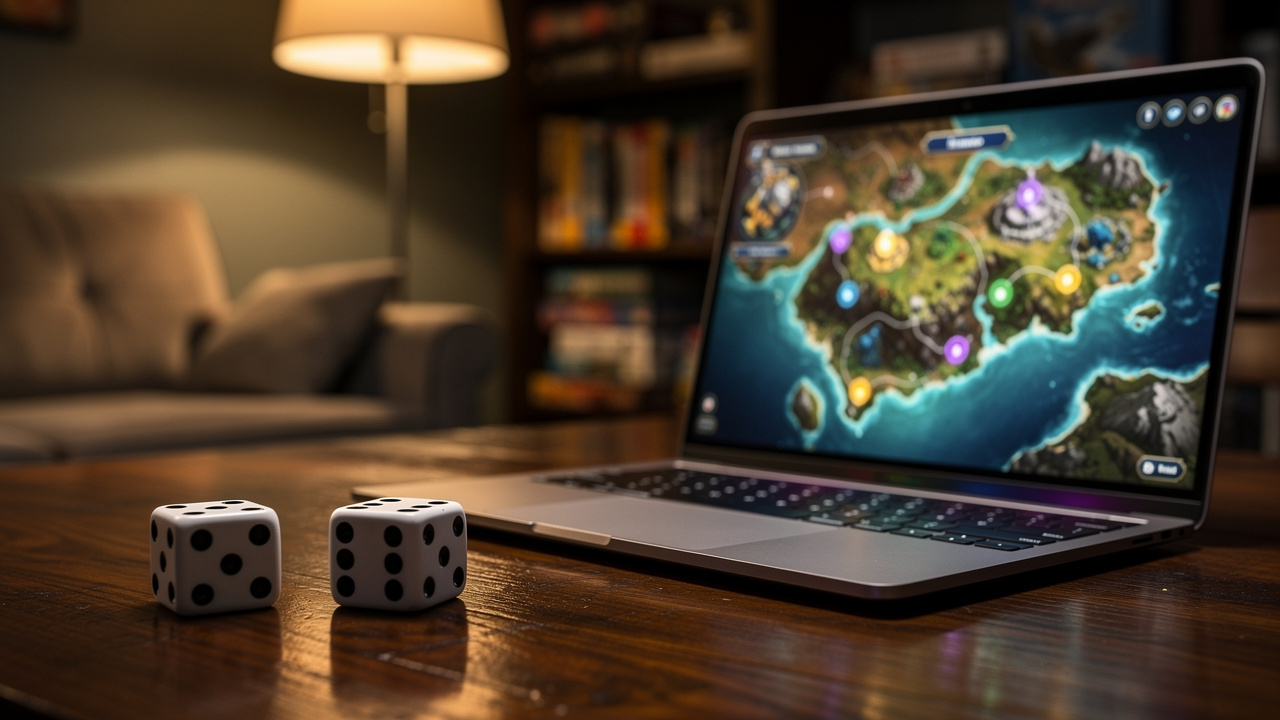
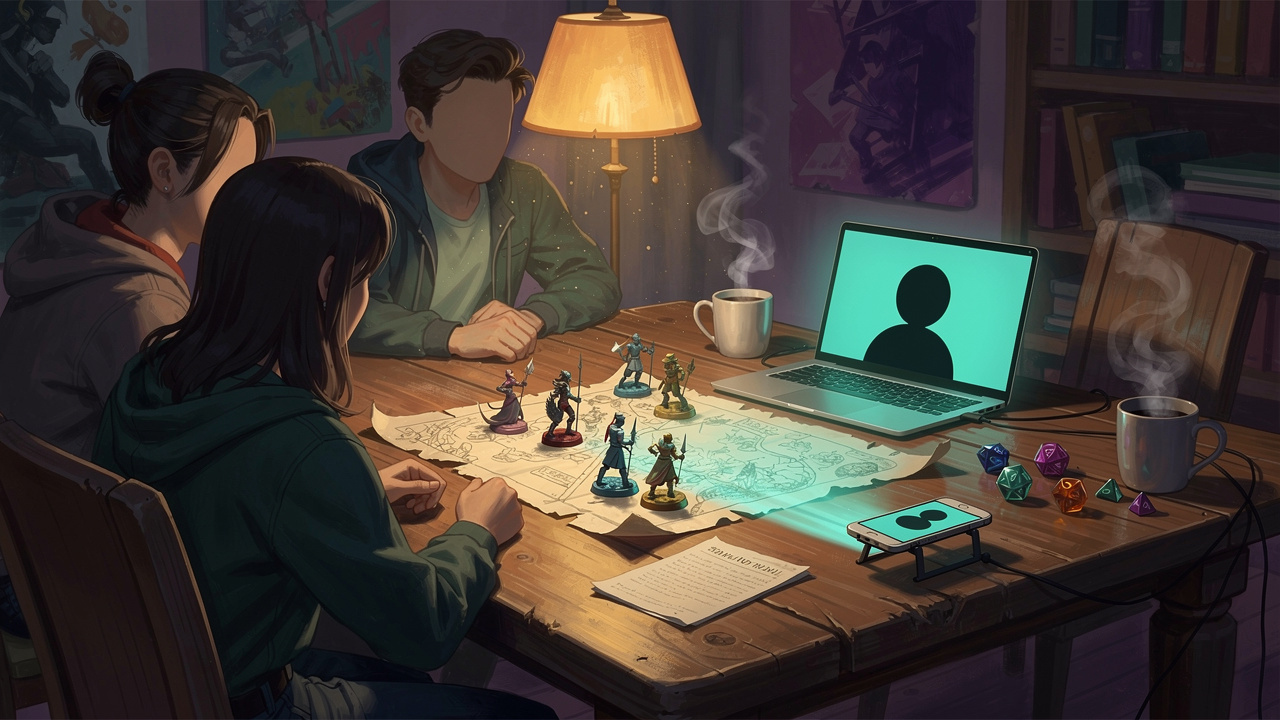
There’s a habit a lot of newer online GMs fall into without really deciding to. You get a VTT set up, Foundry or Roll20 or whatever your table’s chosen, and because it can roll dice for you, click, done, no fuss, you just stop reaching for the physical set gathering dust by your keyboard. It feels efficient. It feels like the obviously correct way to use the tool you’re paying for or self hosting.
Except a fair few experienced GMs will tell you that’s exactly backwards.
The New Shiny Wears Off
When I started playing online on VTTs about ten years ago, it was full digital roller, no question. Partly because it was simpler for a maths challenged brain like mine, and partly because it was new and shiny. But about a year in, I was forever asking the same thing: can I use my dice, please?
That arc is more common than people admit. The case for physical dice at a digital table isn’t nostalgia dressed up as advice, though the nostalgia is real too. It’s that a fully integrated VTT and a fully physical table aren’t actually opposites you have to choose between. Plenty of GMs who run games entirely online still keep a dice tray within arm’s reach, because rolling a d20 by hand is, for a lot of people, simply faster and more satisfying than clicking a die icon and waiting for the little animation to finish.
I’m what you’d call a dice goblin. It genuinely became physically uncomfortable not to roll my own dice. So when a colleague started asking “what if we built a solution for this”, I was right behind him. That itch is basically the origin story of this blog.
Is Clicking Actually Faster?
Here’s the honest answer: yes, technically, it is. In a fully digital set up your hand is probably already on the mouse, so it’s a few small wrist movements, a couple of clicks, and the maths is done for you. If you’re the GM handling rolls for six NPCs in a single combat round, that adds up fast, and for a lot of tables it’s a genuine reason to lean digital.
But speed was never really the point. The real cost is losing the tactile play and the rituals that go with it. Choosing the right die for the moment. Talking to it. Warming it up in your hand before it clatters into the tray. Squinting at the result, wondering if that’s a three or an eight. That’s not a distraction from playing a TTRPG. For a lot of people, it’s part of what playing a TTRPG actually is.
It’s Not Just About Dice
The same logic extends to character sheets, notes, even minis if your setup allows for it. A common pattern is running fully hybrid: a digital character sheet whether playing online or in person, because it’s the reliable source of truth, but inventory tracked on paper, and campaign notes kept handwritten too. GM prep, story arcs, location notes, tends to live in digital folders. But whatever happens in session, the party wandering into a tavern and demanding to know the barman’s name, gets scrawled straight into a notebook because that’s quicker than breaking flow to type it up properly.
None of this is an argument against VTTs. Nobody’s suggesting you abandon dynamic lighting or automated character sheets, they’re genuinely useful, and for a lot of tables they’re what makes online play work at all. The point is narrower and more useful than “digital bad, physical good”: use whichever tool is actually faster and more satisfying for the specific job in front of you, and don’t assume that going digital means every physical habit has to go with it.
The Hybrid Table Question
There’s a hybrid table angle here too, and it’s one Realm Bridge cares about a lot. If even fully online groups are rediscovering the value of physical dice and paper notes, that’s a pretty strong signal for anyone running a genuinely mixed table, some players in the room, some on a screen.
The honest answer here is a middle path, wherever it’s practical. Players should be free to do what they want, as long as the GM has a reliable way to check the results. And failing that, there’s always the ultimate weapon: trust that your players won’t nudge the dice either way.
The in-person players don’t need to give up their real dice to accommodate the VTT. The tools can share the table, quite literally.
Worth Digging the Dice Bag Back Out
So if you’ve slid into always using the digital roller because it’s there, it might be worth digging your dice bag back out, just for a session, and seeing whether the clatter of real dice on a real table still gives you something the click of a button doesn’t. A lot of GMs who’ve tried it say they never really stopped.
If you have something to add to this, come along and join the conversation over on Discord.